
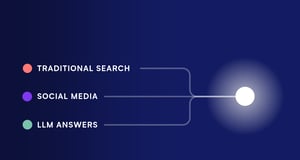
Audiences no longer make decisions in one place. They search on Google, scroll social feeds for a second opinion, and ask AI chatbots, often in one online session.
For PR and communications teams, this means that traditional search, social media, and LLMs can no longer be monitored as three separate channels. The full picture of how audiences are making decisions only appears when you understand each signal in relation to each other.
Cision's 2027 State of Search and Social Report has taken insights from 564 million social posts and thousands of search queries and AI prompts to understand how consumers are moving fluidly between these three touchpoints.
We've collated our thoughts on what this new pipeline looks like in practice below, and the takeaways we think matter most for comms teams.
Table of Contents
How Three Key Audience Signals Intersect
In their report, Cision couples traditional search with private intent, social media activity with public performance, and LLM conversations as somewhere more candid than either.
-
Traditional search volume tells organisations what people are interested in, whether that's a product or a problem they want solved.
-
Social media monitoring adds context to that interest, including what is specifically being said, rising sentiment and key voices.
-
Then, by analysing how LLMs are responding to queries about a topic, teams can understand the additional information that audiences are being fed when they ask exploratory or validating questions.
The catch is that these three signals don't always agree on the state of a conversation and the direction it's moving in. Reading each of these signals independently opens the door to misreading the data. The report's central argument is that their points of disagreement are where the most interesting insights will sit for PR and communications teams.
Six Takeaways for PR & Comms Teams
Organisations that want to ensure they are correctly interpreting the data from these channels need to understand the new 'rules' for analysis that exist between them. Below, we've outlined some of the most useful tips from Cision's report for when teams go to connect these signals to draw conclusions about audience behaviour.
The gaps between these signals are where insights lie.
When search traffic, social conversations and AI answers are telling different stories about the same topic, teams need to ask why they differ and what their differences mean for the bigger picture of how that topic is being perceived and engaged with.
Those gaps could look like an increase in traditional search volume and a decline in social media mentions, or different types of questions being asked between the people using Google versus AI chatbots.
The staying power of trends can be measured with the right data.
One of the hardest parts of working in PR, comms or marketing is estimating how long a trend will last. While social media monitoring is able to alert you to a spike in conversation, that spike could either be a passing fad, or the start of a lasting habit.
Trends are also moving faster than they used to. A Pinterest-commissioned study in 2024 was already reporting that trends are moving 4.4 times faster with 14 times more volatility. Today, this may even be an underestimate of how quickly things change.
To test the staying power of a trend, you need data from multiple sources to ask:
- Is there volume across search, social and AI?
- Is sentiment holding steady?
- Is there already a commercial knock-on effect?
Falling search volume is not always falling interest.
A drop in search volume can mean that a topic has changed shape, or that questions on the topic are more often being brought to LLMs.
Using the automotive sector as an example, Cision data in the report tracked a decline in US and UK Google search interest for terms like "best car," "best family car," and "best SUV" from September 2024 onwards. While this may have been an indication that these audiences are buying less cars, the global trend is the opposite.
Rather than search depleting altogether, it has jumped platforms, with buyers taking conversational questions that require context, and complex research and comparison to ChatGPT, Gemini, or otherwise. For products with larger price tags, like cars, the ability to collate information from news and publishing sites, user review sites, and company pages, is a massive time-saver and valuable resource.
According to research from Adobe, already a quarter of 4,000 surveyed customers cite LLMs as their top research tool during the buyer journey. 42% of AI-fluent customers "always or frequently rely on AI-powered assistants, conversational platforms or AI-powered search as their primary source for advice, shopping or troubleshooting."
Rising search volume can be a dangerous red herring.
Traditional search volume is going to tell you that people are paying attention to something, not how they feel about it. It's vital to understand the actual queries behind that volume, and whether trending queries are navigational, informational, transactional, or commercial.
However, without cross-checking that search intent on social media, teams can miss critical context.
In their report, Cision exemplifies this using a recent shift in search volume within the supplement industry. Since 2022, melatonin had ranked far above alternative sleep aids, owning a 39% Share of Search Volume between September 2022 and August 2026.
A significant spike of more than 17,000 traditional searches for melatonin during November 2025, followed by a sharp fall, may have indicated renewed interest. However, in reality, an American Heart Association study had warned long-term melatonin users that they may be exposed to an increased risk of heart issues.
What your audience says and what they're listening to can be different.
Social listening tells you what people are actually saying about a topic. monitoring AI answers tell you what people are hearing when they ask about it. The themes within both conversations can be completely different, and it's a mistake to rely on one source of information without knowing the context of the other.
In the example Cision provided on the supplement industry within their report, analysis on key messaging within social media mentions of magnesium glycinate compared to AI responses on the topic found that both answered differently when asked about key benefits. Stress relief took nearly half of the Share of Voice on social media, while LLMs emphasised bone support and cardiometabolic support instead.
While the urge to act upon what's trending on social media is valid, as this is where we know consumers are, by monitoring both socials and AI answers, you ensure that you know what your customers are happy to discuss in public, and what details they are receiving from LLMs when they pose private questions. That context should inform the messaging that informs a campaign plan.
In practice, that workflow could look like this:
- Spot the spike or trend on traditional search
- Turn to social media to understand the sentiment and conversation themes
- Before you respond, check what AI tools are saying, so you know what other information your audience is receiving
Search analysis needs to adapt as trends go mainstream.
When a trend enters the late stages of maturity, and even in the early stages of its growth, there are going to be several ways in which it and audience engagement undergoes change. Trend tracking, therefore, really shouldn't stop at monitoring the volume of the trending keyword on the platform, whether traditional search or social media.
In Cision's analysis, they reference the "looksmaxxing" phenomenon as an example of how a trend's cultural relevance can evolve over time, which began as a self-optimisation trend on social media that focused on improving one's physical appearance. Today, it has spawned the rising use of "maxxing" as a suffix, even recently becoming Dictionary.com's Word of the Year.
While traditional search volume for "maxxing" topics declined 55.7% over three months from August 2026, mentions were well and truly up on social media, 807% in fact, year-on-year during the same time period. Micro trends like 'Tanmaxxing,' 'Whimsymaxxing,' and 'Funmaxxing' have become concepts in their own right.
Brands need to track the evolution of a trend to understand how they can respond to it. By connecting search, social, and AI answers signals, teams are able to discover new keywords to stay across, how their social media volumes correspond to search intent, and commercial implications.
The Bottom Line
Search, social and AI each show a different side of the same audience. In isolation, they can mislead teams into mistaking a falling search volume for cooling interest, a spike that turns out to be driven by negative sentiment, or the context that AI is giving their customers.
The teams that get ahead will be the ones that treat these channels as one connected pipeline, and pay closest attention where the signals disagree.
About Streem: Connecting Insights from Traditional, Social & LLMs
At Streem, we deliver a complete media intelligence solution backed by trusted local experts across realtime media monitoring, in-depth analytics and reporting, social listening, AI visibility, and press release distribution, supporting over 1100+ corporate, government, and agency clients across Australia and New Zealand.