
Quick Read
Australian media consumption statistics reveal surprising trends in how Australians discover, engage with, and share news.
Australia's media ecosystem is undergoing one of the most significant transformations in decades, and while traditional channels such as television continue to command trust, digital media - particularly social media - is rapidly reshaping the Australian media landscape.
For companies and communications teams, this shift presents both opportunities and risks. On the one hand, social media usage allows brands to reach audiences directly, often at scale and in real time. On the other hand, the rise of misinformation has led to declining trust in certain content sources, and changing media regulations mean PR teams need to be more switched on than ever before to make sure their message doesn't get lost in the noise.
So, what can we learn from the latest statistics on Australian media consumption, and how can these insights help you to develop a more effective PR strategy for your company?
Why Should Companies Care About How Australians Spend Time Consuming Media?
Understanding media consumption is a strategic necessity for communications teams. Recent reports reveal that Australians remain highly engaged with news, with 97% of Australian users aged 14+ consuming news content monthly. The Australian population is also among the highest globally in maintaining interest in local news stories. However, the way this news is consumed has changed dramatically.
Research from ACMA reveals that social media usage continues to grow, particularly amongst younger audiences. Social media usage statistics published in February 2024 show that 46% of people aged 18-24 use social media as their main source of news.
At the same time, traditional media like television remains highly influential, and is still the go-to during major news events or crises.
For Companies, This Matters For a Few Key Reasons:
-
Media consumption shapes brand visibility and perception
The way an audience consumes media directly influences how they perceive brands. When content is delivered during a trusted news broadcast or by a reputable publication, it often benefits from a 'halo effect', where credibility is automatically transferred from the medium to the message. In contrast, messages discovered casually through social media - such as while scrolling short-form video or influencer content - may be interpreted as entertainment, opinion, or advertising rather than authoritative information. As a result, brands need to align not only their messaging, but also the platform they use to share it, with the overall brand image they want to create, whether that's for leadership, reliability, or relatability.
-
Where you share your content influences the credibility of your messaging
Different social networks carry different levels of trust. For example, audiences tend to view established news websites and long-form journalism as more credible than content they encounter on short-form video-based social feeds, such as TikTok or Instagram. According to the Digital News Report: Australia 2024, Facebook remains the top social media platform for news, especially among under-35s. As of last year, the proportion of under-35s turning to Facebook for mainstream news rose to 68%, up 7 percentage points from 2023.
-
Audience behaviour affects campaign reach and ROI
Campaign performance is ultimately determined by audience behaviour, including when, how, and why people consume content. If your audience is passively consuming your content, engaging for only a couple of seconds before scrolling on, they're less likely to retain your message or even recall your brand. On the other hand, intentional engagement, which is more likely with a trusted source, often results in improved information retention and brand recall. Understanding audience behaviour in this regard will allow you to allocate budgets more effectively across earned, owned, and social media advertising, improving both reach and return on investment (ROI).
-
The rapid sharing of information increases reputational risk
With half the world connected through social media, the speed of information sharing has dramatically increased. A single post, comment, or misinterpreted statement can gain traction within minutes, often before organisations have a chance to respond. As a result, social media now poses a much higher risk to professional reputation, making proactive social media monitoring and listening tools absolutely essential. Companies that can identify emerging issues early and respond quickly are far better equipped to protect trust and manage public perception in real time.
Social Media Platforms: The New Online Leader
Recent social media usage statistics point to a structural shift in the way Australians access information and stay connected. For younger generations, social media is now the primary gateway to news, trends, and public conversation. One of the most striking trends has been uncovered in the University of Canberra Digital News Report: Australia 2025, which found an 8% increase in heavy news consumption amongst Gen Z social media users, with 44% of the demographic now classified as 'heavy' news consumers.
This generational reliance on social media suggests an important shift in how news and media are consumed, one that's likely to stick. And as these audiences age into greater purchasing power and professional influence, their media habits will increasingly define the broader information ecosystem, further shaping the way information is communicated and shared across audiences. This makes platforms with big numbers of monthly active users - such as TikTok, Instagram, and YouTube - not just distribution channels but agenda-setters, with key influence over which stories gain visibility and how they're framed.
For companies, this means PR strategies built solely around traditional or even digital-first news outlets risk becoming progressively less effective over time. While legacy media remains important for credibility and reach today, the data indicates that future relevance will depend on a brand's ability to communicate clearly and credibly within the social environments where younger audiences already spend their time.
For further insights, read our latest report on media consumption in Australia.
The Rise in Misinformation
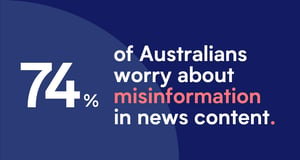
As Australians increasingly turn to social media for news and information, concern about misinformation has surged to some of the highest levels in the world. According to the Digital News Report: Australia 2025, nearly three-quarters (74%) of Australians express worry about the spread of false or misleading content online.
According to Streem data, the keyword "misinformation" received an average of almost 8,000 mentions every month across Online, Print, Radio, TV, Magazine, and Podcast media items in 2025.
Notably, Australians perceive certain social platforms as higher risk than others. According to survey data shared by YouGov, when asked which outlets they believe pose a major misinformation threat, 59% pointed to Facebook, 57% to TikTok, and 49% to X (formerly Twitter).
Beyond general worry, there's a real risk that misinformation campaigns will spread rapidly across large networks of users. Coordinated misinformation efforts, whether driven by bad actors, activism, or automated accounts, can distort public understanding, polarise audiences, and even target brands or marketers directly. Companies that lack monitoring and rapid response systems may find themselves caught in the crossfire of viral misinformation, leaving them vulnerable to reputational risk. For this reason, social media monitoring and social listening tools are more valuable than ever before.
Why TV Remains in the Lead... for Now
Despite the growth in social media usage, television remains Australia's most trusted and widely used news source. According to the Digital News Report: Australia 2025, around 37% of Australians still choose TV as their primary source of news, which is more than any single digital or social media platform.
However, as with all statistics, this headline figure can't be taken at face value. The continued dominance of television for news consumption is heavily skewed toward older Australians in the over-55 age group, while younger generations are moving away from scheduled broadcasts and getting their information from social media.
This generational divide highlights that television's strong showing isn't necessarily a reliable indicator of future media consumption trends; it's largely a reflection of long-standing habits amongst older demographics who grew up with broadcast news as their primary connection to current events. Younger Australians are increasingly turning to social media for news, meaning the overall reliance on TV is likely to continue declining as these younger generations age into greater media influence.
For PR professionals, this dual reality has important implications. While television still offers a broad reach and remains a key way to reach older demographics or mass audiences, it should be balanced with strategies for social media and online news consumption if the aim is to reach a more diverse age group.
The Influencer Marketing Paradox
Influencer marketing is everywhere - especially on social media platforms, where millions of Australians, especially younger demographics, spend significant time. Many Australians, and indeed global audiences, regularly watch influencers, engage with influencer-created content, and even turn to these online personalities for lifestyle advice, news snippets, or product discovery.
While the exact proportion of Australian consumers that engage with influencer marketing remains unknown, we do know that a growing number of Australians under 35 rely on platforms like TikTok and Instagram for news and personal advice, often delivered by influencers through short-form video content. For instance, reports suggest that TikTok is now used as a news source by more than one-third of 18-24-year-old monthly active users, with many of these interactions occurring through influencer-led posts rather than traditional news pages. Stats such as these reinforce the prevalence of influencer-generated content and its role in news media consumption.
Yet while engagement metrics underscore the reach and impact of influencer content, trust in that content remains surprisingly low.
According to the Digital News Report: Australia 2025, Australians consistently rate influencers amongst the most significant sources of misinformation, with 57% identifying online personalities and influencers as a major misinformation threat. As influencer-generated content continues to grow in popularity across social media, so too does the scepticism surrounding it: audiences are increasingly exposed to influencer voices but are equally wary of their authenticity.
The influencer paradox presents both opportunities and risks for companies considering influencer marketing. On one hand, influencer content can quickly drive visibility, start conversations, and connect with hard-to-reach audiences that traditional media might miss - especially if it's delivered by respected or niche creators. But low trust in this type of media means influencer partnerships can backfire if audiences don't believe the content or messaging is authentic. For this reason, seeking influencer partners who align with brand values is vital to ensure your influencer campaign amplifies reach and fosters genuine credibility.
Impact of the Social Media Usage Ban for Younger Age Groups
Australia's introduction of a minimum age requirement for social media access has added another layer of complexity to media planning. While the policy aims to protect children, it also signals a broader cultural shift in the way we understand and scrutinise the role of social media in modern society.
For companies, Australia's social media ban for children has several important implications:
- Youth audiences are likely to migrate to alternative platforms to engage with and consume news and other media
- Parents are becoming more influential gatekeepers, with greater control over the information their children are exposed to
- Brand safety and ethical communication matter more than ever
PR strategies targeting younger demographics must now consider not only where messages appear, but also how they ultimately reach the people in their intended audience, as campaigns are likely to require a change in focus to appeal to parents and their children.
Why You Should Consider Media Monitoring
The speed and scale of today's media environment mean that brand narratives can emerge, shift, and escalate in minutes. With news breaking across traditional outlets and conversations unfolding on social media, the majority of companies need realtime visibility into how they're being perceived and discussed.
Media monitoring has become a critical component of modern PR; a foundational tool for protecting your reputation, guiding strategy, making informed communications decisions, and helping you stay connected with your audiences.
With more time spent on social media every day, the volume of content being created and shared inevitably increases the risk of misinformation, and misinterpreted narratives are more likely to gain traction. Without active monitoring, marketers may only become aware of an issue once it's already spread, leaving limited options for effective response. Media monitoring using a tool like Streem enables your teams to identify emerging risks early, assess their potential impact, and take action before things escalate.
Beyond risk management, media monitoring provides valuable strategic insight. Tracking coverage across broadcast, online, and social channels allows your teams to understand which messages are resonating, which platforms are driving the most engagement, and how audience sentiment is evolving so that you can optimise your campaign efforts to achieve maximum reach and ROI.
Tools like Streem also support proactive storytelling. By analysing data figures, share of voice, and conversation drivers, you'll be able to clearly identify opportunities to contribute meaningfully to public conversation, whether through thought leadership, timely commentary, or targeted engagement. In a fragmented media landscape where audiences encounter content incidentally rather than intentionally, Streem Media Monitoring gives you the insights you need to drive active engagement.
Ready to see what Streem can do for you? Book a demo today.
How Companies Should Adjust Their PR Strategies
As Australian media consumption continues to evolve, companies need to recalibrate their PR strategies to reflect where attention, trust, and influence now sit.
One of the most notable opportunities emerging from recent research is the resurgence of local news.
According to Streem data, mentions of the keyword "local" within Australian headlines outperformed mentions of the keyword "national" by 34% in 2025. Audiences are increasingly engaging with local outlets for community-relevant information, trusted reporting, and hyper-local issues that national media may overlook.
For companies, this presents a valuable opportunity to build authority and relevance by tailoring stories to local markets, spokespeople, and community impact, rather than relying solely on national coverage.
At the same time, it's important to acknowledge that younger audiences are consuming information very differently. To reach Gen Z and younger Millennials, PR teams need to be turning their attention to short-form video content across platforms like TikTok, Instagram, and YouTube. These formats are now central to how Australians encounter news, social commentary, and brand messaging, so translating key announcements, insights, or thought leadership into short, visually engaging video content can significantly improve reach and recall with these audiences.
It remains clear that a blended approach is critical.
Traditional media, particularly TV, still plays an important role in authority and scale, especially amongst older demographics. However, it should be complemented by digital-first storytelling, platform-specific content, and selective influencer partnerships that prioritise authenticity over reach alone.
Given the speed at which narratives now form and spread, companies should also ensure they have a focus on a social media monitoring strategy. Active monitoring enables companies to detect emerging issues, track misinformation risks, understand audience sentiment, and measure how messages perform across channels in real time. Without this visibility into social media usage, even well-planned campaigns can be undermined by fast-moving online conversations.
Ultimately, the most effective PR strategies will be audience-led, platform-aware, and insight-driven. To see the insights Streem can unlock for you, book a demo of our media intelligence solution today.