

Although PR and communications professionals will know that reporting is a monthly, weekly, and sometimes daily affair, End-of-Year (EOY) reporting is a whole new ballgame. As the year wraps up, teams have to benchmark their performance with broad and granular perspectives.
Have our goals and KPIs been met? Are we heading in the right direction? While End-of-Financial-Year (EOFY) reports aim to reconcile the previous 12 months of the communications budget with ROI, EOY reports draw focus to specific campaigns, what performed well and what needs to be improved or cut.
Here’s how to create a presentation that translates to leadership and provides practical value to your team as you consider the year ahead.
🗣️ Why EOY Reports Are More Important Now Than Ever Before
Where culture goes, the communications sector will follow.
Both consumers and organisations face enormous amounts of online and offline content every day. To cut through the noise, campaigns are being driven by data that understands when the best time would be to release that press release, what sources specific audiences are watching, and how media mentions actually relate to quantifiable business outcomes.
To get that data, teams need to track patterns that matter to their organisation.
Often, it’s only at the end of a year that changes from the previous one come to light. To make accurate observations that also assist with long-term communications planning, end-of-year reporting is the best way to show and create impact.
If your team is already stretched thin, you may not have the time to do this yourselves. Streem has a team backed by experts in Australian media who can develop this bespoke reporting for you. Delve into the deeper insights behind trends and get data-driven recommendations based on this analysis for the year ahead to help you fill gaps and find opportunities. Get in touch with us to have a conversation here.
1. Start with Your Previous New Year’s Resolutions
The first step in this process should involve a retrospective on the communications goals and KPI standards that you set for the past year.
Whether this is your total volume of media coverage, media quality, or spokesperson visibility depends on your specific organisation and what has been most important to your brand narrative. Although there are metrics that every EOY communications report should include, the ones that are spotlighted are variable.
Not only should you begin by answering the question of whether these goals have been met, also take time to consider whether these goals retained their importance over the course of the year. As is often the case with our highly volatile media landscape, things change.
For example, your primary goal this past January might have been to increase the quality of media you were receiving by tracking domain authority. However, if in March, you realised that the true cause of your low-impact campaigns was a lack of engagement with social media-first outlets, it’s important to note this journey as it can provide valuable context for subsequent campaign decisions.
2. Create a Clear Timeline of Branded Coverage Volume & Spikes
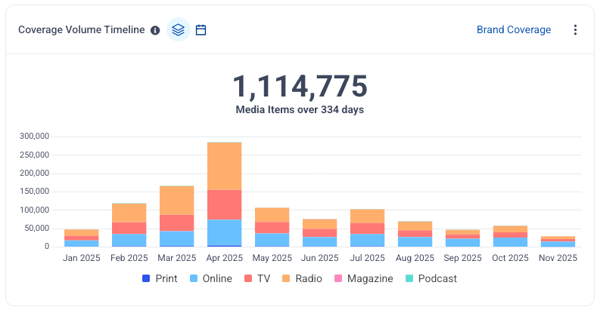
Building a clear timeline of your branded coverage volume is probably the most important visual you can provide in an end-of-year report. Pull out month-by-month benchmarking to identify where spikes occurred and why. Make sure to chart the key brand moments you had this year, which might include:
- Product launches
- Key PR or marketing campaign timelines
- Crisis events and your response effectiveness
- Major company milestones and celebration coverage
- Earnings announcements and subsequent coverage sentiment
(Hypothetical brand coverage data)
For branded media coverage, month-on-month and quarter-by-quarter benchmarking are the best ways to get a comprehensive view of when your brand was in the media this past year. More granular benchmarking is more useful later on when analysing the effectiveness of specific communications strategies.
Pro Tip: While benchmarking media coverage, try to quantify and categorise the brand moments that happened each month so that it’s immediately clear which mattered more. If in the above sample timeline, April only incurred one brand moment, that would instantly say a lot about how important that was for your team, and why, for example, you might have prioritised a follow-up strategy in May. You’d also be able to identify which types of brand moments have more impact.
2. Media Quality and Priority Sources
While your team may already have an idea of which media sources are most important to your brand, it’s vital to understand where there have been changes. Take steps to analyse where your stories were distributed, heard, and shared to inform next year’s channel planning.
Key Branded Metrics To Track:
- Leading Online Sources
- Leading Print Sources
- Leading Print Journalists
- Leading Online Journalists
- Leading TV Programs
- Leading Radio Programs
- Top Influencers
- Coverage by Media Type
- Mentions by Platform
Once you have an understanding of where your brand has been mentioned most, take note of your average domain authority.
This metrics is essentially a search engine ranking score that predicts how well a website ranks on Google.
In other words, the website's reputation and competitive value. The domain authority of your branded mentions is a significant indicator of your earned media quality. While you may be earning more total media coverage compared to last year, it's important to know whether this coverage is taking place on high-ranking sources that will cut through.

(Hypothetical brand coverage data)
3. Identify Media Patterns Specific To Your Organisation
Every organisation will interact with the Australian media landscape differently, depending on owned content and campaigns, the industry you’re within, your stakeholders, spokespeople, and a whole host of other factors.
Each year, the patterns in the relationship between your brand and the fourth estate will become clearer as news outlets and audiences settle into their behaviours. Some, of course, will evolve, and it’s because of this that EOY reports should endeavour to identify where media coverage patterns have remained stable and where there are new insights.
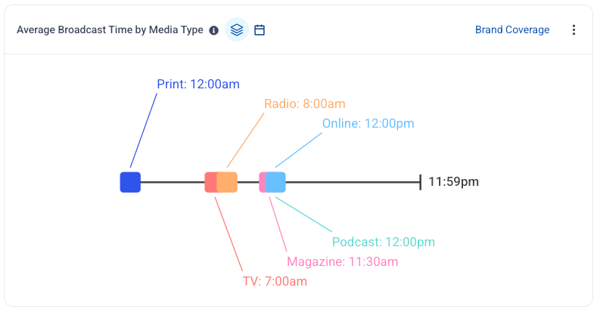
For example, what time of day do your press releases get picked up by the radio?
By analysing the past 12 months of radio coverage and the spikes you would have already identified, you can find out. A chart like the sample below, for example, shows that Radio coverage averaged an 8:00 am start time. Podcasts, another audio option, were released around noon. This information is invaluable for campaign planning, especially if you’re aware of both when and where your audience is most engaged.
(Hypothetical brand coverage data)
Another useful pattern to track is the trajectory your organisation’s media coverage tends to take between earned and social media.
Does news tend to break on social media first, or are journalists engaging with your brand before the public does? Does this depend on what type of brand moment is occurring? Knowing these trends helps establish a clear picture of where stakeholders are, especially with the rise of social media journalism, as well as which channels to prioritise.
Pro Tip: To find what media patterns are distinct to your specific organisation, repeat this process for your industry at large as well as for your competitors. This process can help you find gaps in key conversations and the right timing to add to these conversations.
4. Highlight Your Campaign Performance
After you’ve gained a top-level overview of your organisation’s media coverage, take a look at how your individual campaigns performed. Note their start and end dates to assess how long each one appeared in the media for compared to their overall coverage volume.
Key Campaign Metrics to Track:
- Coverage Volume
- Mentions & Website Traffic Visibility
- Spokesperson & Executive Visibility
- Themes
- Potential Audience Reach & Total Audience Reach
- Volume of Print Coverage by Page
- Volume of Online Coverage by Position
- Key Messages
- Mentions Benchmark Timeline
- Coverage Volume & Stock Price
- Top Performing Post
- Total Social Shares
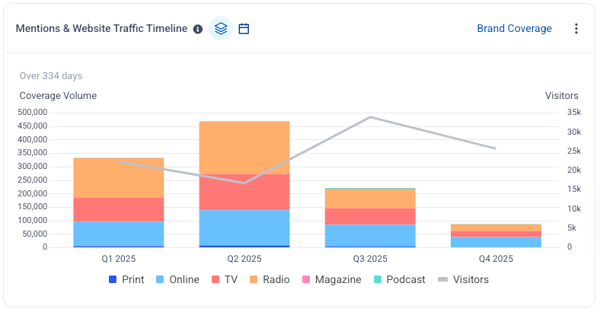
One significant metric to highlight here is the relationship between mentions and website traffic.
By charting your website traffic over your total mentions across media types, teams will be able to note where sales conversions can be traced back to website visits that have aligned with communications efforts. This is just one way to connect back to real business outcomes and establish ROI. Another is to correlate your media coverage with share price movements.
(Hypothetical brand coverage data)
5. Assess Your Competitive Landscape
EOY reports are the perfect opportunity to take another look at the foundational competitor analysis you use for ongoing communication strategies. While you continue to adapt, so do they. As a result, it’s important to look at the landscape with fresh eyes when you can.
Consider the share of voice within mentions of your industry at large to see who won most of the conversation this year. Take a look at the branded coverage volume of each competitor to see where their spikes occurred and for what reason. Did they run a similar event to an event that your team ran? Compare campaign metrics and assess where there is room for improvement on your end.
6. Provide a Future-Focused SWOT Analysis
EOY reports are nothing without context and clarification.
As a communications professional, one of the most important parts of the job is explaining where the brand narrative has been, where it’s headed and why this relates to the organisation’s bottom line. Consider including a brief SWOT analysis at the end of your presentation with information on where you saw strengths, weaknesses, opportunities, and threats this year, and what you plan to do next year to take full advantage of your learnings.
In Conclusion
The EOY reporting season is a busy time for us all. There are many different avenues that teams can take in regard to what kind of data they pull out and how they present it. However, while each report will evolve depending on past and future communications goals, these guidelines can act as the foundation for any team looking to translate their efforts in a clear and succinct way to senior leadership.
Streem’s Commitment to Keeping You Informed
At Streem, we are committed to keeping you informed about the latest developments in the media landscape. We deliver a complete media intelligence solution backed by trusted local experts. Featuring realtime media monitoring, integrated traditional and social analytics and reporting, social listening, and press release distribution, Streem supports 1000+ corporate, government, and agency clients across Australia and New Zealand.
Ready to elevate your media monitoring and insights? Contact Streem today, and let’s start shaping your communication strategies.